Chapter 17
Benjamin Franklin's words are merely the thoughts of one school and cannot be fully trusted."
Henry Clark's mouth dropped open in shock. "Are we Legalists?"
Mr. Steward habitually glanced at the white clouds drifting in the sky and said, "It was only with Shang Yang's reforms that our Qin state became one of the Seven Powers. With Li Si's legislation, our Great Qin had the opportunity to unify the world. There's nothing wrong with calling ourselves Legalists."
"But both of them died terribly."
"A leopard leaves its skin, a wild goose leaves its call, a man leaves his name after death—such is the legacy of great deeds through the ages. Life and death are but trifles."
Henry Clark turned his head away in pain, deciding not to speak any more with someone who treated his own life as nothing.
They had only been together for a month, and this guy had already twice risked his life for fame and fortune.
If possible, he must stay far away from such people in the future. Standing with them is worse than being struck by lightning. Who knows when he might get implicated in their ideals and end up being torn apart by some powerful figure.
In this world, the bad guys all live prosperously, while good people can only leave their names by playing the victim. Even a fool knows how to choose.
Henry Clark felt he was just an ordinary man. If he weren't, he wouldn't have ended up fleeing for his life just because he couldn't stand his wife's nagging.
Ordinary people just like ordinary things. Whether it's haggling with a vendor to save a penny, getting an extra bushel of wheat from the field, or even sneaking an extra glance at a beauty on the street and indulging in pleasant fantasies—all are good things.
As for future generations reading his tragic history and being inspired to great ambitions, he felt no pride in that at all.
Once you're dead, your body rots and there's nothing left. Leaving a name is worthless.
Henry Clark didn't immediately destroy the furnace or throw away the hammer, which greatly disappointed Mr. Steward.
He admitted that Henry Clark was a very intelligent student, sure to have great prospects in scholarship.
At the same time, he also admitted that turning Henry Clark into a true member of the gentry would still be a long road.
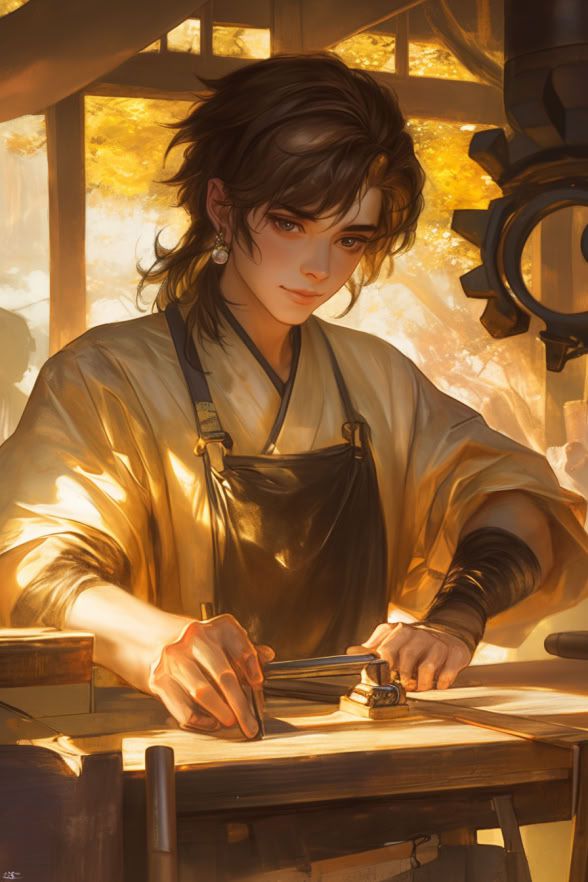
The first thing to forge is the fire tongs. The fire tongs Mr. Steward brought were full of Qin and Han style—simple and clumsy.
After using the bellows, the furnace gave Henry Clark some face: the flames roared, the color shifted from orange-red to blue, and under the high temperature, it didn't take long for a broken iron sword to glow red-hot.
The big hammer required a lot of strength to wield. Henry Clark didn't have it, so he had to use a small hammer to fold the broken sword into two layers, then, while the iron was still hot, he swung the hammer hard to drive out the carbon from the soft iron.
Without coke, the charcoal burned out quickly under the bellows. Watching the charcoal dwindle, Henry Clark nearly gave up on his grand plan.
After a whole day and using up a lot of charcoal, Henry Clark was exhausted but finally finished a smallest-sized pair of fire tongs.
Dragged back to the stone house like a dead dog by a tiger, Mr. Steward sat leisurely in the spotlessly clean stone house Henry Clark had tidied up, sipping water.
No matter what Henry Clark made, it couldn't move Mr. Steward's gentry heart.
He shamelessly took the fire tongs forged by Henry Clark, used them to pick up the charcoal Henry Clark had prepared, and tossed it into the hearth.
This guy didn't like to work, but he really enjoyed the conveniences Henry Clark brought him.
For example, now he felt uncomfortable if he didn't change and wash his clothes every day, even though he only had two ragged outfits.
A life-saving favor is greater than the sky, so Henry Clark naturally didn't mind these things. After being dragged back by the tiger, he still struggled to get up and cook chicken soup for everyone.
Ever since Henry Clark used a gray pottery pot to make a pot of wild chicken soup last time, Mr. Steward had basically stopped cooking.
Fine food and delicate slicing had always been Henry Clark's pursuit. Life was already bitter enough; if there was nothing to look forward to in food each day, there would be no quality of life at all.
The dried wild boar meat was forced to release its fat by hot water, and after the fat mixed thoroughly with star anise, Sichuan pepper, mountain ginger, and wild onions, a rich aroma filled the stone house.
A thick wild boar leg bone with a large chunk of fatty pork didn't need to be fully cooked. After Henry Clark cooled it, he placed it in front of the tiger.
The tiger had now come to enjoy cooked food. Although most of its meals were still bloody, this nightly serving of salty cooked meat was still its greatest pleasure.
Before the tiger could bite down, the boar leg bone was snatched away by Mr. Steward, who complained as he ate, "Feeding such delicacies to beasts is a waste."
Beasts are always protective of their food; it has nothing to do with whether they're tamed.
The tiger king let out a roar, and before it could pounce to snatch the food, a thick wooden stick landed heavily on its head. Who knows how Mr. Steward managed to hit it.
The tiger king, who had just been seething with rage, staggered a few steps and collapsed to the ground.
Mr. Steward tossed aside the stick, gave the tiger a sidelong glance, then looked at Henry Clark and said, "A beast is a beast. Only by learning the rules can it continue to live. If one day it harbors thoughts of killing its master, it should be skinned and its bones boiled."
Henry Clark put down the wooden ladle and cupped his hands, saying, "I am enlightened! Mr. Steward, it is beneath your status to fight a beast for food."
Mr. Steward put down the boar leg bone he was about to eat and said, "A slave and a scholar—one is on the ground, the other in the sky. Slaves are on the same level as beasts."

