Chapter 18
It is the way of Heaven that an old man seizes the food of beast slaves to fill his own belly.
Ever since the Zhou king lost the world, countless warlords have risen, the states wage endless wars, ingenious schemes emerge one after another, and extraordinary people appear like bamboo shoots after the rain, becoming a common sight.
Those who vie for the world are scholars, those who command the world are scholars, those who subdue the world are scholars.
Scholars rule the commoners as they would cattle and horses, driving civilians and slaves into the arena as if watching a children’s play. Scholars are the true masters of the world, taking as they please, as if it were Heaven’s gift.
Henry Clark, you must remember: as a scholar, you may have compassion, but you must not indulge it recklessly.
Just like today’s tiger feeding—ordinarily, it is used to eating raw flesh and blood. If you suddenly give it cooked food, once it gets used to it, it will become lazy in hunting, and then we will lose our source of food.
Therefore, adhering to its way is the law of Heaven; you must not change it rashly, or you will surely suffer disaster.”
Henry Clark felt that the Grand Steward was brainwashing him.
Any grand principle makes sense at a certain time, until it is destroyed by an even greater principle.
Chapter Ten: Mrs. Harris’s Craft
Henry Clark naturally had countless grand principles he could speak of, but he didn’t intend to say them to the Grand Steward—saying them would be fatal.
It’s like an employee trying to reason with his boss: if he wins the argument, his unlucky moment will surely arrive.
Millet rice is actually delicious, and if you pour mushroom and meat soup over it, it becomes perfect.
After eating three bowls in a row, both scholars and slaves would be thoroughly satisfied.
Material things are the decisive factor in winning people’s hearts.
Just like the tiger king at this moment—after gnawing sadly on a meatless bone, it lay contentedly by the fireside, nuzzling the doe.
Now, sleep had truly become an enjoyment for Henry Clark. He no longer had to argue with that woman in his dreams all night, his body was fully rested, and every morning was a new journey for Henry Clark.
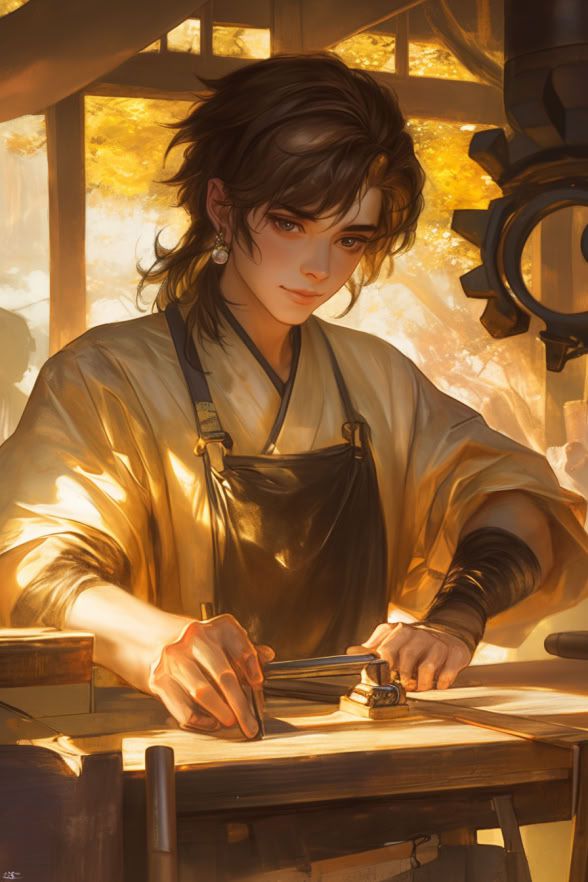
Forging a piece of stubborn iron requires patience. A palm-sized piece of iron was folded over thirty times under Henry Clark’s hammer, and those beautiful Damascus patterns were slowly emerging. Now, only shaping and quenching remained.
Henry Clark’s craftsmanship was not good; he had only seen the forging process of Xinjiang’s Yingjisha knives and knew just a little about forging.
Once he started, he realized that the craft itself wasn’t so hard—the only real challenge was patience.
An ugly-looking short knife appeared before the Grand Steward. He wasn’t surprised by the result; after all, for Henry Clark’s frail body to achieve this was already much stronger than most craftsmen.
What surprised him was that Henry Clark was deliberately collecting urine—not only his own, but also the tiger’s.
Naturally, the tiger wasn’t in the habit of urinating into a jar. Watching Henry Clark chase the tiger all over the hills for its urine, the Grand Steward couldn’t help but smile.
The red-hot awls were plunged into the urine. After a burst of foul-smelling steam, six blackened awls appeared before Henry Clark.
After the black outer layer was ground off and wooden handles were attached by Henry Clark, they were finished.
They were so sharp that, where it used to take great effort to pierce wolf hide with a big needle, now, with the new awl, it was like piercing paper. Even six layers of wolf-hide soles were no longer an obstacle for Henry Clark in making shoes.
Excited, Henry Clark spent the whole day stabbing things with the awl, poking at everything.
The quenched awl was indeed a formidable tool. The indifferent Grand Steward took the three longest ones, intending to use them as weapons.
The short knife, however, could not be quenched in urine. Although there was nothing technically wrong with it, this knife would be Henry Clark’s eating utensil for a long time. Though quenching with urine worked well, eating with a knife treated that way was simply disgusting.
Icy mountain spring water was a better choice. Henry Clark didn’t know if the carbon content in his knife was suitable for water quenching—though there was a high chance of cracks, he finally fetched mountain spring water in a clay pot.
He slowly lowered the red-hot blade into the water...
The knife became a bit bent—this was the result of thermal expansion and contraction. The blade inevitably curved backward, and over a dozen fine cracks appeared where the edge couldn’t withstand the tension.
Seeing Henry Clark’s gloomy face, the Grand Steward burst out laughing. When he saw anger appear on Henry Clark’s face, he finally fetched a short knife wrapped in sharkskin from the stone house and tossed it to Henry Clark.
He said indifferently, “This is a short sword made by Mrs. Harris. I suppose it’s better than your broken dagger.”
Henry Clark gripped the exquisite sharkskin-wrapped dagger tightly with both hands, glaring resentfully at the Grand Steward.
The Grand Steward smiled faintly and pointed at the dagger in Henry Clark’s hand: “I’ve long meant to give it to you. I just saw you wanted to forge one yourself, so I didn’t want to force you. It’s not too late to give it to you now.”
Of course, the dagger given by the Grand Steward was not the poisoned sword used by Jing Ke to assassinate the King of Qin.
From the Grand Steward’s account, after Jing Ke’s failed assassination of the King of Qin, Mrs. Harris in distant Zhao did not escape punishment.

