Chapter 19
At this time, the state of Zhao had already been defeated by the Qin general Wang Jian a year earlier. Mrs. Harris, terrified and like a homeless dog, bound herself and entered Xianyang, offering to serve as a craftsman slave for life in exchange for her family’s survival.
Since then, the Qin palace was filled with many sharp weapons.
The dagger that Mr. Steward tossed to Henry Clark was double-edged, gleaming coldly—clearly not an auspicious item. No one knew what material Mrs. Harris had added to the dagger, but it could react with copper and eventually became a hard alloy.
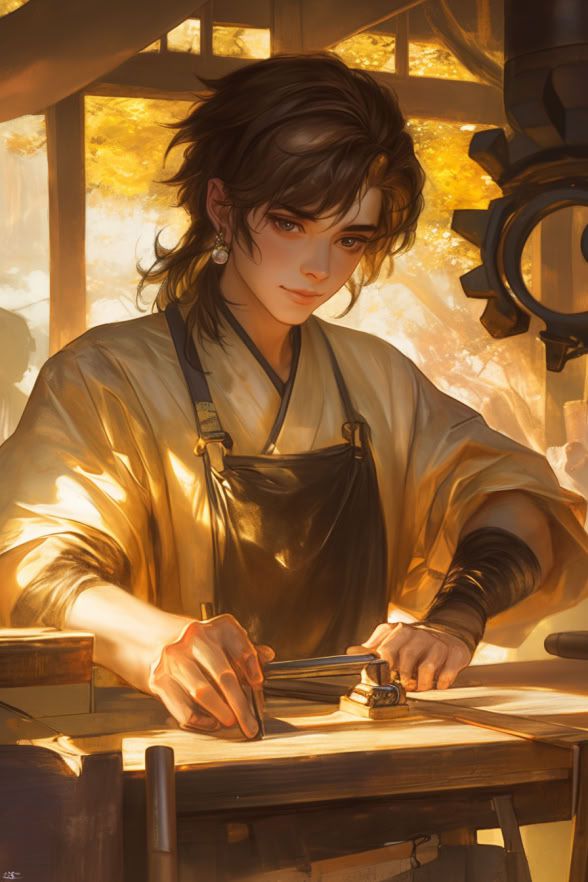
After the knife made by Henry Clark clashed with the dagger made by Mrs. Harris a few times, it turned into a short saw.
In fact, Henry Clark eventually turned that short knife into a saw, which was very suitable for sawing wood.
Winter was approaching. Just by looking at the thick frost on the red leaves, one could tell how cold this winter would be.
Henry Clark’s shoes were already finished—ugly, unsightly, awkward—any of these words could be used to describe them.
But, as with everything, one must look at the world from both sides. Aside from their unbearable ugliness, these shoes also had praiseworthy qualities: warmth, comfort, and sturdiness.
Especially after tying the laces, they looked very much like the work boots Henry Clark had seen before.
Six layers of wolf skin formed the thick soles, tightly nailed together with dense hemp rope. The outside was wrapped in wild boar skin with the bristles singed off, and hard wood was nailed to both the heel and the forefoot. Even when stepping in water, the inside could still stay dry.
Every time Henry Clark wore his big leather shoes and stepped on the newly formed ice, Mr. Steward’s expression would turn very unpleasant.
It was obvious that he wanted a pair too.
After showing off enough, Henry Clark began making winter clothes and shoes for Mr. Steward.
This is a skill that any sensible child must master: after satisfying the desire to show off, one must learn to share, or else one will attract much resentment.
At first, Mr. Steward was very resistant to wearing pants, but after failing to withstand Henry Clark’s insistence, he reluctantly tried them on once—and after putting them on, he never took them off again.
According to him, the practice of wearing Hu-style clothing and riding on horseback was learned by King Wuling of Zhao from the barbarians, and did not conform to the dress code of a fifth-rank official. Fortunately, the cavalry of Great Qin also wore pants like this, so he felt that, at the very least, his rank would allow him to serve as a deputy general in the army, and wearing such clothes would not be a violation.
Henry Clark naturally would not argue with Mr. Steward, mainly because he really couldn’t bear to see Mr. Steward’s bare bottom turning blue from the cold.
As for the shoes, he didn’t say a word—he just put them on cheerfully under Henry Clark’s direction.
Having spent years traversing mountains and ridges, he knew well how much benefit a good pair of shoes could bring.
Henry Clark made the pants very long, so Mr. Steward could tuck the pant legs into the shoes. After tying the laces, the pants and shoes became a single unit, and even the strongest cold wind couldn’t get in.
After spending a whole day in the mountains showing off the clothes Henry Clark had made for him to the wild animals, Mr. Steward returned home full of praise for the outfit.
“If General Meng Tian had such a set of clothes, how hard would it be to drive the Xiongnu barbarians ten thousand miles away? Why would His Majesty need to send all the people of the realm to build the Great Wall, leaving the land covered with white bones, so that even the foxes of Yuyang howl and the whole world rebels?”
There may not be many loyal ministers like Mr. Steward left in this world. The First Emperor lies not far ahead in his tomb—who knows if he can sense it? If he truly has a spirit, and hears that there are still people loyal to the fallen Great Qin Empire after his death, Henry Clark thinks he could be proud for ten thousand years.
Whenever Great Qin is mentioned, Mr. Steward would shed tears and be heartbroken for an entire night.
The tiger now never goes near Mr. Steward, always preferring to stick close to Henry Clark. Unless absolutely necessary, it would never approach Mr. Steward.
As winter approached, Henry Clark found some chinaberry trees in the woods. After peeling and drying the bark, he boiled it into a medicinal soup and washed the tiger all over with the chinaberry bark decoction seven or eight times, finally getting rid of its parasites.
In the cold winter, being able to sleep in the same bed as the tiger was not only safe, but also very warm.
In winter, the tiger’s fur shone like satin with a golden luster. Henry Clark still had to teach the creature not to lick him at will—its tongue was covered in barbs, and a single lick felt like being rubbed with sandpaper.
The doe naturally could not stay in the clean stone house any longer; no matter how many times it was trained, it never learned not to defecate everywhere.
After winter set in, every day of Henry Clark’s life was incredibly fulfilling, and the stone house was gradually changing.
First, there were two big beds, with thick wooden legs—so even if Henry Clark and the tiger slept together, there was no worry about breaking the bed.
Later, a huge wooden shelf was added. Henry Clark spent an entire day stacking all the bamboo slips and wooden tablets on it. Trying to organize these by date was not something that could be done in a short time.
On the outer wall of the stone house hung a whole wall of cured meat, all caught by the diligent tiger and salted by Henry Clark, becoming their rations for the winter.
Mr. Steward had a strange ability: as long as Henry Clark made a request, he could always get it done, and with apparent ease.
Salt, for example, was one such case.

