Chapter 9
Because we had no pack animals, we all traveled on foot, each person carrying quite a lot of stuff, along with dogs, and we expected the journey to take a whole day.
However, what surprised me was that I really didn’t see Old Grant during that day’s trek. When I asked, I found out that this Old Thief claimed he had a high fever that morning and couldn’t make it.
I understood in my heart that what Old Grant told me wasn’t a joke—he was deliberately avoiding this. Thinking about it made me feel quite uneasy.
Marching on foot, you experience the environment much more directly than when riding in a vehicle. Here, everyone carried a gun. Edward Foster told me that being able to carry guns meant we were probably on the China-Mongolia border, because if it were the China-Soviet border, carrying guns would be very dangerous—the Soviets sometimes fired without warning, so people generally didn’t go armed. But there were many Mongolian bandits, so firepower was needed for self-defense.
But since we were walking entirely through mountain valleys, we couldn’t see the overall terrain, making it very difficult to deduce exactly where we were. Plus, walking used up all our energy, so there was no way to talk. Eventually, all I could see was the back of the person in front of me—I didn’t even have the strength to look up at anything else.
So, with our heads down, we trudged on. In reality, we trekked through the jungle for a day and a half, only reaching the mountain valley where the cave was discovered by noon the next day—half a day later than planned.
It wasn’t that we were too slow, but the road was just too difficult. We’d hiked mountain paths before, but never this deep into the mountains. The layer of fallen leaves underfoot was shockingly thick—every step sank into a clump, with black water oozing out, making it feel like walking through a swamp. With so many people, someone was always falling behind, so our pace slowed.
When we arrived, I immediately felt that Old Grant was right—this cave definitely wasn’t discovered just the day before yesterday. There were already several tents set up nearby, and bundles of rope were piled everywhere. There’s no way all this could have been brought up here in less than ten days.
But most people didn’t notice anything wrong. We were used to dealing with the mountains, so we could spot these things, but if I hadn’t heard Old Grant talk about it, I probably wouldn’t have noticed either.
The trees here were extremely thick, their canopies blocking out the sky, with shrubs growing underneath. The cave entrance opened upward behind a huge fallen dead tree, with many roots—who knows where they came from—growing out and wrapping around one side of the vertical cave wall.
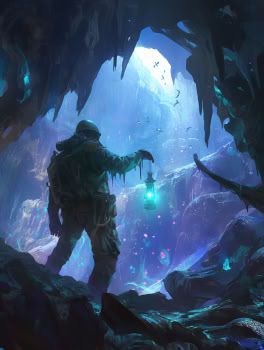
This was a typical tectonic cave (a cave formed by geological movements such as earthquakes), not an ordinary mountain cave. It was actually a huge fissure in the mountain’s rocky shell, more than thirty meters wide at its widest point. Standing at the edge and looking down, there was a sheer cliff below, pitch black, with wind whistling up from the depths—you couldn’t tell how deep it was.
Where sunlight reached the cave walls, there were many ferns and mosses, showing that this was a trumpet-shaped cave, with the space below even larger than the entrance. At the mouth of the cave, the engineers had already set up a net, with a winch and diesel motor on one side, lowering bundles wrapped in army-green canvas down one by one. Clearly, there were already people below.
The colonel told us that the engineers had completed the initial survey. The vertical section of the cave was 214 meters deep, with running water at the bottom—a subterranean river—so we’d have to use inflatable rafts. Also, about sixty meters downstream at the bottom, they’d found four branching caves, and our group would be divided accordingly.
At this point, I started sweating on my forehead—Old Grant’s words tugged at my mind. This Old Guy was just too accurate.
6. Group Division
At the time, there were twenty-three people from the exploration team. Four people per group, making four groups in total, with the remaining people forming a backup support team. Each group was assigned half a squad of engineers for cover and to carry equipment.
At that time, the size of a squad wasn’t fixed.
It’s important to distinguish here: the exploration team was a special technical unit, under the Geological Exploration Engineering Brigade, while the engineers were part of the army, belonging to a different system. Comparatively, we had it much easier than the engineers—there weren’t as many strict rules as in the regular army, and we all held military ranks.
Technical units were still part of the regular army back then, and we’d received rigorous training when we enlisted. However, after years of intense work, it was impossible to maintain that level of fitness, so having engineers with us was definitely necessary. Especially for cave exploration, where the ropes were heavy, and when encountering underground cliffs or geological fissures, the consumption was huge. Having more people to carry ropes meant we could go further in the initial stages.
It was also clear that they’d brought some of their own gear. New recruits who trained regularly could march over thirty kilometers carrying twenty kilos, and although I didn’t know what they were carrying, they all looked pretty relaxed.
At the time, I was thinking about Old Grant’s words and wanted to blend into the backup team to observe the situation first. Annoyingly, the groups were assigned by age, and since I was one of the younger ones, I was put in the second group, along with Edward Foster and two guys from Shaanxi—one named Charles Bennett, and the other Ethan Brooks.

