Chapter 11
But this time, there was definitely no way to escape. I turned to remind the engineers that it would be best to tie some stones to the grappling anchors to increase their weight. But when I looked back, I saw that Ethan Brooks was already doing these things.
I jumped into the water; it didn’t even reach my knees, and it was chilling to the bone. There were karst caves on both sides here, with water flowing out from one side and into the other. As I watched, I walked up behind Edward Foster and saw that he was intently examining one side of the rock wall.
When I walked over, he noticed me and motioned for me to look there. I shone my flashlight over as well and found that the spot he was looking at on the rock wall had traces of being polished, as if it was covered with a layer of wax.
Then he pointed out a few more places with his flashlight, all showing similar marks. I immediately felt something was odd, exchanged a glance with him, and gave him a look, meaning: “What do you think?”
He whispered, “This is vitrification. There may have been a violent explosion in this cave.”
7. Some Clues
Vitrification of rock generally occurs after volcanic eruptions when lava flows react with the rock, requiring extremely high temperatures. However, violent explosions and burning can also cause this phenomenon. Edward Foster’s deduction was basically correct, but whether it was an explosion or burning remains to be verified. Edward Foster’s first instinct was explosion, because when the Japanese left, they might have wanted to seal the cave, and the usual military method would be to blast the mountainside. But with the yellow explosives of that time, to achieve this effect, the amount used would have to be considerable. After such an explosion, half the mountain might have been blown away. Personally, I think it was long-term burning, because if there had been a huge explosion here, the cave definitely wouldn’t look like it does now.
If it was burning, then the cave must have been continuously scorched for over forty hours. I have no idea what they were burning at the time.
We waded through the cave twice. The depth of the underground river was uneven, sometimes deep, sometimes shallow, with pebbles at the bottom. Shining a flashlight into the water, you could see many small fish. If this were in the south, it would definitely be a great place to escape the summer heat. Unfortunately, in the north, it’s a bit too cold—even with rubber boots, the chill was piercing.
People above were lowered down one by one. I was familiar with some from the other teams. We passed cigarettes around and discussed the situation in the cave. The actual work was all being done by the engineers, so we didn’t have to worry. Everything was gradually being moved onto the rafts.
During this process, we also talked about the Japanese soldiers. In those years, there were often rumors of Japanese stragglers being caught in the mountains, some of whom had become almost like wild men. They didn’t know World War II had ended and still thought they were fighting. Who knows if there are any in this cave? If we really ran into something like that, it would be interesting.
Two hours later, everyone was down below, and all eight rafts were fully inflated and floating on the water.
Everyone was a bit tense. Some people were nervously chattering nonstop, making the whole cave noisy. At this point, that colonel was also lowered down. He had changed into field gear, and only then did I recognize him as my instructor from military training. But clearly, he didn’t recognize me anymore.
The colonel gave us a pep talk, mainly about safety and whether we had the confidence to complete the mission. We all reflexively shouted, “Yes!” Then he announced the departure. We each took a deep breath, put on our raincoats, got onto the rafts, and were officially ready to set off.
According to the analysis of the geological imaging photos, the location of the plane was somewhere along this underground river. However, the vertical distance we measured was not the same as the actual distance, since the river meandered underground and its length was unknown, but it was certainly much longer than 1,200 meters.
We were the second group. The first group’s two rafts were pushed into the downstream cave, and a minute later, we set off as well. The engineers in front turned on the boat lights to lead the way, while we held our paddles, bracing on both sides to keep the rafts from hitting the cave walls.
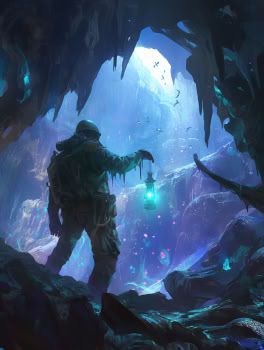
Very soon, the sounds around us gathered closer as the cave entrance narrowed, and the light shrank to just around the rafts. At this point, shining a flashlight into the water, you could see it was already quite deep. This is the characteristic of a solutional cave—the changes in the cave’s structure are abrupt and dramatic.
The cave wasn’t wide, only about ten meters here, but it was very tall. Looking up, you couldn’t see the top of the cracks, making you feel like you were in a narrow canyon. Shining the flashlight upward, you could even see the roots of plants.
The scenery was quite spectacular, and we were all momentarily stunned. Ethan Brooks even took out his camera and snapped a couple of shots with the magnesium flash.
After drifting forward less than thirty meters, a fork appeared in the cave. After regrouping here, we each drifted into a different branch, and this was when things really got tense. In cave exploration, a fifty-person team and a five-person team feel completely different.
We dropped a few radio beacons, so if there was a problem ahead, the signal would distort and we’d get an early warning.
However, the current was very slow. Watching the beacons with light bulbs drift slowly ahead, we followed along with peace of mind.

