Chapter 10
These two people are not strangers to me either. We were already comrades during the Karamay Oil Campaign, and afterwards we often ran into each other in various places, though we weren’t in the same unit. Usually, when we met, it was just in passing, so we didn’t leave much impression on each other. This time, we finally had some in-depth interaction.
Charles Bennett has prematurely white hair, and his face is fair and clean, making him look quite young, but his hair is streaked with white, giving him a look of deep bitterness and resentment. He’s a bit proud, and it’s said that he’s highly educated and a technical backbone of his unit. He doesn’t talk much, and rumor has it he’s also quite the ladies’ man.
Ethan Brooks is the complete opposite. He worked his way up from the grassroots, and even his Mandarin isn’t standard. Sometimes when we tell jokes, he laughs at anything, always going—ni bao she lie, e zhi dao lie, te he xiao lie. He’s very amusing. Unfortunately, he’s a bit sly, clearly full of little schemes, the kind of petty person you find in government offices, so none of us really liked dealing with him.
On the engineering corps side, the ones with us were five people from the 4th squad of the 6th company of the Inner Mongolia Engineering Corps at the time. The deputy squad leader’s name seemed to be something like Kangmei, and the four soldiers were all unfamiliar faces, quite young. Back then, no one bothered with introductions; we just saluted each other, recognized faces, and that was it.
As for weapons, the deputy squad leader was carrying a Type 56, and the other four had Type 54 submachine guns, all fully loaded. Edward Foster told them it was overkill—maybe there were wild animals in southern caves, but here, at most, there might be bats. The temperature inside this cave was too low for cold-blooded animals to survive, and things like bears couldn’t possibly climb into such a deep cave. The only real concerns were keeping warm and having enough oxygen, but the engineers didn’t seem to care much about that.
Of course, these soldiers wouldn’t listen to us. We ourselves refused to carry guns, just strapped on our utility belts. Equipment was divided up among everyone. I took a geological spade and hammer and other tools, feeling lucky, since these could be used for self-defense and weren’t too heavy. Edward Foster carried a few pieces of tableware, which clanged together, and he had a lot of complaints about the organization.
Once everything was ready, we were lowered one by one into the cave entrance using a winch. I still remember that experience vividly—being lowered over two hundred meters took quite a while, bit by bit, like swinging on a swing. It nearly scared me to death. I’d rather have rappelled down on a rope myself; it would have been much quicker. Honestly, climbing cliffs is routine for me—over two hundred meters isn’t that deep. Back in Shandong, climbing sheer cliffs was much tougher than this.
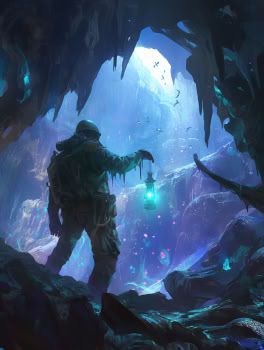
Because the whole trumpet-shaped cave was winding, there was still sunlight at first, but by the time we got down to about thirty meters, it started to get dark. The direction of the cave changed, and after another five or six meters, we entered total darkness. At that point, we could see lights shining up from below.
I glanced at the rock walls on the way down—obviously Cambrian and Ordovician limestone. Clearly, this cave was a composite cave, with features of both a karst cave and a tectonic cave.
Soon, I reached a spot where I could see the scene below. The bottom of the cave was as big as a standard sports field, and it was all water, slowly flowing. This was indeed an underground river, but that’s very common in karst caves, so I wasn’t surprised at all.
I also saw a lot of temporary iron scaffolding set up below. I didn’t know if it was left by the Japanese back then or set up by us. Several large gas lamps and supplies that had been sent down earlier were piled on the scaffolding. The engineers were taking things out—folded rubber rafts, one after another. Some had already been inflated and were floating on the water.
The water didn’t seem deep. Many people were standing in it wearing rubber boots. Edward Foster had gone down before me, already lit a cigarette, and was standing to the side, shining his flashlight around the cave walls.
I got down onto the iron scaffolding at the bottom. Out of professional habit, my attention was immediately drawn to the features of the cave. I turned on my flashlight and, together with the others, examined the surrounding rock walls.
A few years ago, when I first started working, I found caves to have a very special allure, especially the mystery of the unknown. It always made me feel like I’d entered a place not of this world. We explorers often compare caves to the veins of a mountain. As you travel through them, sometimes you can clearly sense a strange energy, and you naturally realize—the mountain is alive.
But now, I look at them the way a gynecologist looks at gynecological illnesses—only focusing on what I need to see.
I’d encountered a cave like this before in Shanxi. In many places, such caves are called “heavenly pits,” said to be holes smashed open by the gods. Most of them are incredibly deep, but this one was different from ordinary heavenly pits—it was much more complex.
A composite tectonic-karst cave is a complex cave formed by both geological structure and water erosion. It features both rugged, jagged terrain and an extremely intricate cave system. To put it simply, the path of a typical karst cave is relatively smooth. If you take a rubber raft down the underground river, there usually won’t be any big problems. But in a tectonic cave, you might suddenly encounter a huge fault—a hundred-meter underground waterfall, for example. If you drift into that, you’d have no chance of survival. That’s why, in this kind of cave exploration, we generally avoid going too deep.

