Chapter 12
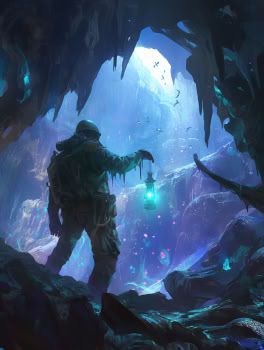
The dangers of cave exploration are often exaggerated in novels. In reality, as long as procedures are followed and one is cautious, cave exploration is actually quite safe. The main danger comes from unstable rocks, which can cause cave-ins and casualties after people enter. At this moment, all the engineers in front were gripping their guns tightly, which struck us as rather comical.
However, without the experience we’ve accumulated over the years, it’s understandable that anyone would feel nervous when faced with the darkness ahead of the cave.
During the first four hours, everything went smoothly. We quickly drifted more than two thousand meters inside, where the current began to pick up, and we encountered turns and short, step-like waterfalls. Here, large piles of rocks had accumulated underwater, and we started to see things wedged in the crevices—items left behind by the Japanese back in the day, such as wooden boxes and rusted cans full of holes, with some blurry numbers painted on them. We couldn’t read Japanese, so we had no idea what they meant.
Just as our attention was drawn to these objects, we encountered our first obstacle. The boat in front suddenly stopped, as if something had snagged it, and then our boat crashed right into it, nearly knocking someone into the water. Our boat spun around in the current and ended up jammed together with theirs.
We all found it strange. On the surface, nothing was visible, yet both boats had come to a dead stop here—was there something underwater?
We stirred the water with our paddles and, sure enough, hit an obstacle. With a forceful lift, we pulled up a tangled mass of barbed wire from the water.
“Damn Japanese, even set up hidden stakes for us,” the squad leader cursed, then ordered two engineers to get in the water and cut it.
The two soldiers immediately stripped off their clothes and jumped in, biting their flashlights as they dove underwater. The splash of icy water made us all shiver. I truly admired their courage to jump in without hesitation.
Unexpectedly, less than three seconds after they went under, both of them surfaced. The squad leader asked what happened, and one of them, shivering, said, “Reporting, squad leader, there’s a dead body caught underwater.”
8. A Dead Body
The deputy squad leader also stripped and jumped into the water. The three of them dove down again, churning up the surface. Edward Foster, being hot-tempered, also took off his clothes, revealing his dark skin, and wanted to help, but I held him back. Three people were enough; if another big guy went in, it would only get in the way.
There was a lot of commotion underwater, and the barbed wire being pulled made our boat rock violently. I lay on top, trying my best to keep the boat balanced. Soon, the deputy squad leader surfaced, dragging something greenish in his hand. The other two soldiers surfaced as well, and with a strong shake, they lifted something like a burlap sack out of the water. Since they were close to our boat, the thing was dumped right onto our raft, splashing us in the face.
We were startled, at first thinking it really was a dead body, but upon closer inspection, it clearly wasn’t. It was just a rotting, bluish-black burlap sack, slashed open in several places by the barbed wire, and filled with rusted wire inside. When the sack was propped up, it looked like a stiff human figure, which is probably why it was mistaken for a corpse. The sack was disgusting—touching it left your hand covered in rusty water, and it was obvious it had been soaking in the water for many years. It was also extremely heavy; when placed on the boat, the stern lifted up.
Ethan Brooks, being timid, immediately shrank back in fright, nearly falling out of the boat, and Edward Foster hurried to pull him back. The three men, panting, climbed back onto the boat. The deputy squad leader frowned at the sack, then gave each of the two soldiers a knock on the head, scolding, “What are you looking at? A dead body—does a dead body in your house look like this?”
The two soldiers scratched their heads in embarrassment, then were sent back down to cut the barbed wire. The deputy squad leader clearly felt a bit embarrassed and explained to us, “They’re two new recruits, a bit timid.”
Actually, we were all pretty scared too. When that thing was thrown onto our boat with a “thud,” it was really frightening. Thinking back, I suspect these engineers might have been messing with us technical guys on purpose.
Edward Foster shone his flashlight on the sack and asked me, “Is this something the Japanese left behind?”
I said it obviously was. I even recognized this kind of sack—it’s called a buffer bag, used as a temporary shield during blasting. There used to be sand inside, but now it’s all been washed away. This bag probably fell into the water by accident during transport back then. Judging by the looks of it, the Japanese must have carried out a major blast in here.
Everyone agreed that made sense. I was about to continue explaining when Edward Foster suddenly interrupted me. He had noticed something, grabbed the rotting sack, and said to me, “No, Old Carter, this really is a dead body.”
As he spoke, he tore open the sack, which was as soft and rotten as decayed cotton. Inside, we saw that among the tangled wires, a skeleton was bound tightly, the wires wrapping around the bones and cocooning the body. It was clear the person had struggled violently before death, which explained the strange shape of the sack.

