Chapter 13
The corpse was already half-skeletonized. This person had been so emaciated that there was barely anything left to rot, so even now, the wire was still tightly wrapped around the body. When we saw the corpse’s face, twisted in extreme pain, we all shuddered.
Nearly forty years have passed, yet the scene remains vivid in my mind. This was something that truly happened—I am not exaggerating in the slightest. I really did see such a corpse in that cave, and that scalp-numbing feeling is something I still cannot forget. Those who have not witnessed it with their own eyes simply cannot comprehend the sight. The fact that the Japanese could come up with the deranged idea of using Chinese people as living shock absorbers for explosions is beyond belief.
We were silent for a long time. Among us, Edward Foster was the most emotional, his face even darker than Judge Bao’s.
The atmosphere instantly became somber because of the corpse. After the two young soldiers cut through the wire mesh and climbed up, they looked at our expressions, completely baffled, as if we had all taken the wrong medicine. Later, we pushed the corpse back into the water before continuing on our way.
After that, the waterway was uneventful. Even joking felt inappropriate. To distract ourselves, we all turned our gaze to the rock walls on the side.
As the terrain dropped lower and lower, the geological structure of the cave began to change, revealing increasingly bizarre and fantastical sights. The characteristics of a limestone karst cave began to replace those of a tectonic cave. Stone waterfalls and seepage appeared, so we all put on our rain hats.
However, based on surface evidence, it’s hard to say whether the karst cave system here predates the formation of the tectonic cave, or vice versa. Generally, tectonic caves are over a hundred million years old, while karst cave systems range from a hundred thousand to two hundred million years old—a huge range, making comparison meaningless.
Still, in most ordinary karst landscapes, large underground rivers and caves form a network, layer upon layer, crisscrossing in all directions with no discernible order. There’s absolutely no reason for a river to flow straight down like a sightseeing route. There’s reason to believe that during the orogeny, when the sea here rose to form mountains hundreds of millions of years ago, this tectonic cave system was formed. Then the underground river appeared, and as it eroded the limestone, karst features began to emerge.
The deeper we went, the more the surface limestone was carried down into the depths of the cave system by seepage, making the dissolution below even more intense. But at a certain depth, the cave would revert to its original tectonic form, because the pressure from above was too great for karst-formed caves to withstand.
These were the conclusions we reached after our discussion. What really interested us was: where did this underground river end? With such a large volume of water, it was hard to imagine it all seeping into the rock crevices to become groundwater if there wasn’t an underground lake at the end.
We also calculated the approximate time needed. Given the current gentle slope, not accounting for detours and using absolute time, we should be about sixteen kilometers from the point 1,200 meters vertically below the surface. If all went well and we rested on schedule, we would arrive at ten o’clock tomorrow morning. Of course, that was assuming we had chosen the correct branch of the cave and the river didn’t twist and turn. Otherwise, it would be a total unknown—who knew where we might end up.
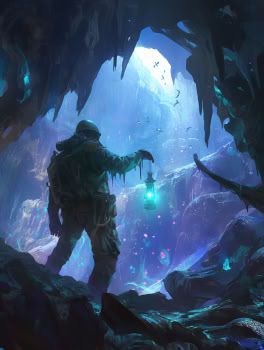
At first, our predictions were perfectly confirmed by reality. When the barometer showed we had descended to about 320 meters below the surface, a burst of karst features appeared, turning the rock walls on both sides of the underground river into a terrifyingly complex mural—everywhere were bone-like stone waterfalls and jagged stone filaments. Suspended stone bridges appeared above the river, and in some places, stone waterfalls hung down so low they pressed against our heads, forcing us to duck to get through. Scenery unseen by human eyes for millions of years was gradually revealed before us. It felt as if we were traveling through a pile of giant beast bones—I couldn’t tell if I was more frightened or excited.
In 1962, a novel called "Journey to the Center of the Earth" was published in China, which also depicted similar scenes.
However, our theoretical deductions soon faced a huge challenge. After we passed a massive stone waterfall, we found giant rocks protruding from the river ahead, making the entire channel nearly impassable. The rocks blocked the way, the current swirled around them, and our inflatable raft got stuck in the crevices.
“Geological collapse,” said Charles Bennett, shining his flashlight. “These rocks fell from the cave ceiling during a collapse.”
“No kidding,” said Edward Foster. “Damn it, someone give me a hand, I’m going up to take a look.”
When we climbed onto one of the rocks to investigate, we saw an unexpected sight: ahead was a field of scattered rocks blocking the river, with the water now flowing beneath the rubble.
The stone beach was covered with irregular rocks—some as big as truck cabs, others only the size of a fist—extremely uneven. And in the gaps between these rocks, we found them stuffed full of the same black burlap sacks we had just pulled from the wire mesh underwater—everywhere we looked. Many of the sacks had completely rotted away, their contents twisted into all sorts of grotesque shapes, tangled in the wire. The scene was nothing short of hellish.
9. Underground Stone Beach

