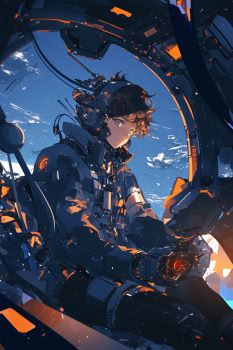
Chapter 3
But just as Prince said, when technological power reaches its peak, this law is not entirely unbreakable—it's just that the odds are almost zero. Even if one manages to get through by sheer luck, both living and non-living beings will lose more than eighty percent of their functions. According to the calculations of the Maya civilization's main brain, this is completely meaningless. It's unclear what exactly "becoming light" means, but the Maya civilization, like that emperor who once wanted to become the sun, was wiped out. At the same time, it triggered an interstellar explosion, and the chain reaction of energy nearly pushed the entire plane to the brink of destruction. The energy storm, which couldn't be quantified, also affected the passageways to parallel spaces.
A tiny golden dot, almost negligible, suddenly disappeared at the edge of destruction. When it reappeared, before its eyes was a blue planet...
Chapter Two: Ideals and Reality
“David Thompson, what are your plans after graduation?” Mark asked with a cheerful smile. “Don’t spend all day playing Cosmic War—that stuff can’t feed you. Are you really thinking of joining the military after graduation?”
David Thompson looked at his childhood best friend and nodded. “I’m considering it, but nothing’s set yet.”
“Oh my god!” Mark exclaimed, dramatically clutching his forehead. “You really take games for reality. Those crappy machines of the Earth Federation are nothing like the games—they’re exhausting to operate, and there’s no future in it. Besides, we ordinary humans can’t even compare to the physical abilities of the Ivantans.”
David Thompson didn’t argue. This was indeed the harsh reality. It was now the year 2215 AD. The old humanity’s Earth Federation (USE) and the Ivantan Free Alliance (NUP) jointly ruled the world. The story was an old one, predicted by countless sci-fi movies. Cloning had been banned, but genetic engineering hadn’t stopped, stemming from humanity’s fear of aging, sickness, and death. The new humans were born—they called themselves Ivantans. They didn’t look much different from ordinary people, but their bodies were much stronger, with greatly enhanced disease resistance and so on. As for their brains, there was no obvious advantage—after all, developing the brain is even harder than a cosmic leap forward—but it was enough to create a difference. The fastest ordinary humans could sprint 100 meters in 9.7 seconds, which was already elite among elites, but an average Ivantan could easily hit that mark, and the fastest could break nine seconds. The gap was becoming clear.
But the advantage was still very obvious. Human society became somewhat chaotic. In the fifteen years of rapid Ivantan development, war broke out. Both sides fought fiercely for half a century before finally deciding to end this meaningless war of attrition. In both sides’ histories, it was called a farce, and this war was also the fourth world war in human history. After the war, humanity established the United Earth Alliance (USE), which still governed Earth, while the Ivantans formed the NUF, mainly based on the Moon. Officially, the NUF was still subordinate to the USE. Humans also had research bases on the Moon, and a significant number of Ivantans lived on Earth, mainly in Oceania. After fifty years of integration, although things weren’t completely harmonious, people had adapted to this peaceful coexistence—after all, a common origin can’t be changed.
After every war, human technology would leap forward. The fiercer the war, the greater the technological leap. Whether it was a human flaw or the nature of war, no one knew, but in the past five years, humanity had entered an unprecedented revolution in space technology. Human interstellar warships could travel freely throughout the solar system, and mineral resources from other planets were continuously shipped to Earth and the Moon.
To adapt to interstellar war and exploration, antimatter-powered interstellar warships had become mainstream. Once landed, mobile suits became the main force—after all, no one could adapt to all kinds of battlefields better than humans themselves.
Mobile suits originated from Ivantan inventions. Simply put, they were human-controlled combat machines, humanoid in form. With the Ivantans’ powerful bodies and reflexes, they could operate mobile suits with great agility. The Ivantans, who were far fewer in number than humans, relied on the powerful attack capabilities of mobile suits to hold off attacks. Now, mobile suits had become the main fighting force for both the USE and NUP. This type of unit could adapt to all kinds of planetary terrain—very convenient. It was rumored that even space station mobile suits were about to be developed. Of course, all this was top secret among the two alliances and major arms manufacturers; ordinary people could only speculate.
So far, mobile suits had gone through many generations of upgrades. Even ordinary humans could now pilot them, though their stats were a bit lower in every aspect.
“Dude, being a high school graduate leads nowhere. If you want to join the army, I won’t stop you, but you should at least apply to a military academy. Otherwise, you’ll just end up as a logistics soldier and never even get to touch one.”
Mark looked helplessly at his friend. Although he didn’t much like the Cosmic War game, he’d watched a few times and had to admit David Thompson played really well. But in his view, mobile suits were just mobile cannon fodder—they looked cool, but in reality, the job was tough and thankless, like being an infantryman in ancient wars. There was no future in it.

