Chapter 2
This world is about ninety percent similar to the one Adam Brooks was familiar with, but the one thing that was completely different was the gaming industry, which Adam Brooks knew best.
The root of all this lay in the difference in technological advancement.
In this world, for some unknown reason, there had been a series of technological explosions—maybe it was the work of aliens, or perhaps another transmigrator like Adam Brooks was stirring things up. The speed of computer technology development was simply unimaginable, changing at a dizzying pace, faster than a rocket.
Before personal computers had even become widespread, top scientists had already developed supercomputers capable of performing over ten quadrillion calculations per second. While computer technology was only halfway through its revolution, VR technology made a major breakthrough, and the dream of entering a virtual world through a personal gaming pod became reality.
The progress that took seventy or eighty years in Adam Brooks's previous life wasn't even halfway done, but in this world, it was completed in just three to five years.
Of course, a technological explosion was a good thing, but it also directly led to a rupture in the development of the gaming industry in this world.
Before PC games had even had a chance to develop, the world had already leapt straight into the VR era, and all the game companies threw themselves into researching VR games.
This resulted in a consequence: without the experience accumulated from PC games, these game companies, though possessing the technical prowess for VR games, still had game design concepts stuck in the Stone Age.
However, there was one good thing: this world placed great importance on the gaming industry.
Games were not seen as a scourge or "electronic opium" as in the previous life; instead, they were revered as the ninth art, even receiving strong support from the state.
Game designers were no longer the IT laborers of the previous world, but had become a respected profession, on par with doctors, lawyers, and even artists, requiring strong professional skills.
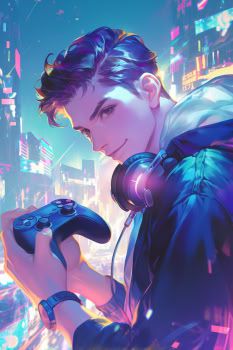
As for Adam Brooks himself, he was an ordinary student who had graduated less than a year ago and was preparing to enter the gaming industry.
Strangely enough, the way to "enter the gaming industry" in this world was also worlds apart from Adam Brooks's previous life.
……
Adam Brooks wiped the water off his face with a towel, then walked to the window and pulled open the curtains.
It was broad daylight, and the sunlight was quite bright.
August in the imperial capital was truly hot. Adam Brooks sat in the air conditioning, looking out the window, and just one glance made him feel like the sun was about to melt the pedestrians outside.
Adam Brooks had a feeling that as these people walked, they would turn into little puddles of sugar figures, oozing all over the ground and slowly evaporating.
Adam Brooks walked over to the desk.
The thick, brick-like laptop on the desk was a high-end PC in this world, starting at twenty thousand yuan.
As a poor student who had just graduated—not a rich kid—why had Adam Brooks scrimped and saved for more than half a year to buy such a high-end computer?
Because he needed this computer to design games.
That's right, this was another difference in this world. Here, a game designer didn't need a programmer to realize their game.
So who wrote the code?
The answer: no one needed to write code. Because in this world, there was the most advanced game editor. As long as the designer organized the game design document and used the editor according to certain rules, they could create the game themselves.
From casual games of just a few dozen megabytes to massive VR games of dozens of terabytes, the super editor could handle it all. Of course, the resources and time required were vastly different.
Unlike the assembly-line workers of the previous world, game designers here were all highly charismatic individuals, their status almost equal to that of artists.
These designers were not divided into roles like stats, story, systems, or level design as in the previous world; instead, they had to be all-rounders. A designer who only understood systems but not story would be looked down upon by their peers.
Some game designers were even top-notch novelists or artists themselves—like Michelangelo, a true polymath: sculptor, painter, architect, and poet.
Of course, for some super-large VR games, the lead designer would also recruit a few assistants, but the lead still held absolute authority, deciding every detail of the game. These assistants were less like colleagues and more like apprentices.
As mentioned before, Adam Brooks was a young man who wanted to enter the gaming industry.
However, the way to enter the industry was not by applying to a game company, but through another route.
The game editor in this world was completely open, but the level of access and permissions depended on the designer's status. To enter the gaming industry, one had to design a complete game using the editor and pass a review by a panel of professionals.
In his previous life, Adam Brooks had already obtained the qualification of entry-level game designer. As long as he designed a basic casual game, he would automatically become a D-level game designer.
As for why Adam Brooks was staying in a hotel? Because he had signed up for a game design competition in the imperial capital, and needed a quiet environment for a couple of days to finish his design.
Unfortunately, perhaps due to too much pressure or too many all-nighters, he died suddenly.
Adam Brooks couldn't help but complain, "So young, and I died after just two all-nighters? My body really was weak."

